
Policy & News
How Congestion Pricing Is Reshaping Neighborhood Demand
By Jingjing Feng · May 28, 2026 · 8 min read
Dan McCoy — Public domain · Wikimedia Commons
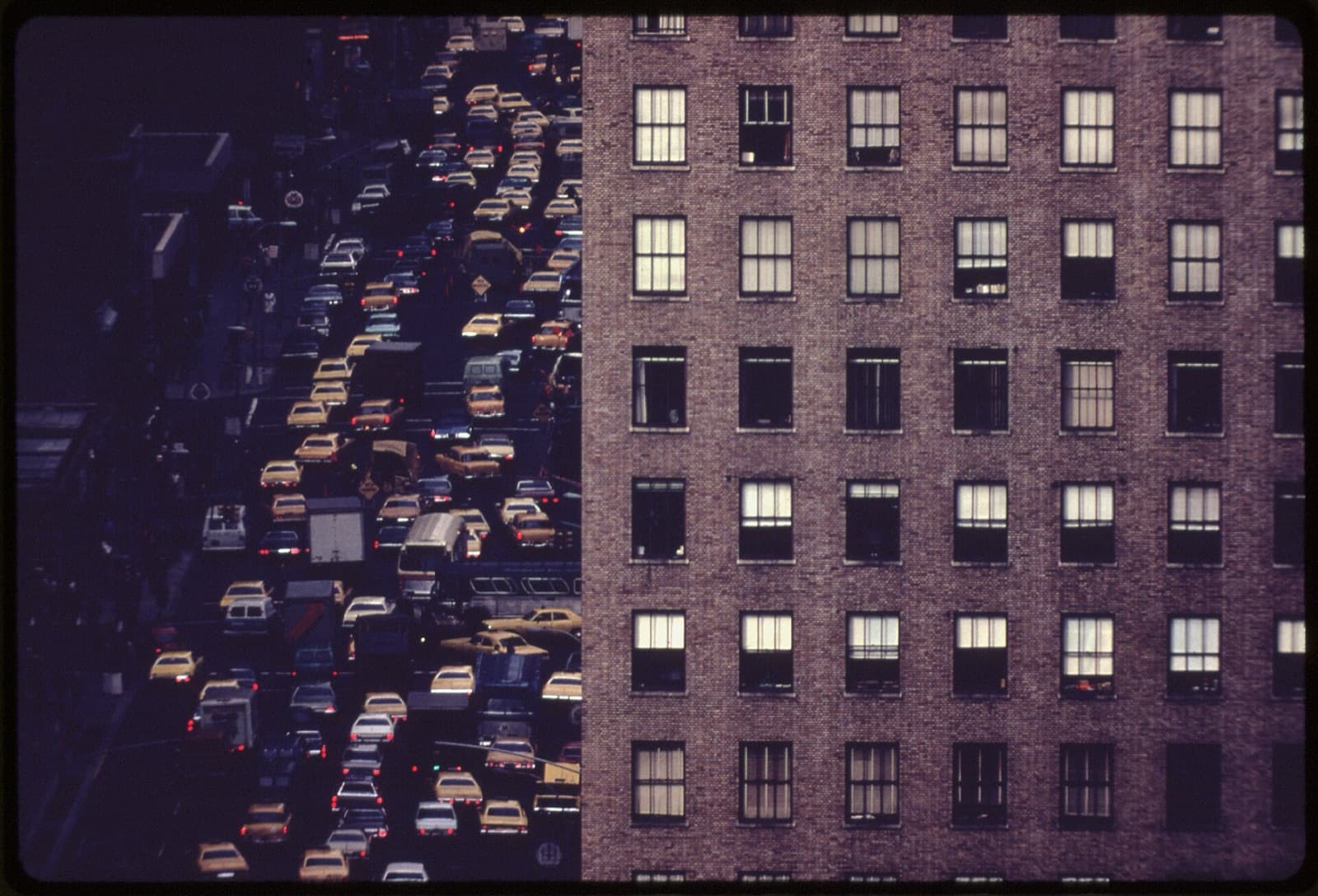
On January 5, 2025, New York became the first city in the United States to charge drivers a toll simply for entering its busiest core. Eighteen months later, the debate has shifted. The question is no longer whether congestion pricing would survive its lawsuits and politics — it has — but how a single line drawn across 60th Street is reshaping where people in the greater-New-York region actually want to live.
For Mandarin-speaking buyers, students, new immigrants, and investors weighing a move, this is not abstract policy. It is a real monthly number on a commute, and a quiet shift in what makes one neighborhood more convenient than another.
As of June 2026. Tolls, hours, and discount rules are set by the MTA and change periodically. Confirm current figures at the official sources linked at the end before making any decision.
What the rule actually is
The Congestion Relief Zone covers the local streets and avenues of Manhattan south of and including 60th Street. The FDR Drive, the West Side Highway / Route 9A, and the connections to the Hugh L. Carey Tunnel are excluded — you can drive past the zone on those roads without paying.
The current charge for a passenger car using E-ZPass:
| Item | Detail (as of June 2026) |
|---|---|
| Peak toll, passenger car | $9.00 |
| Overnight toll, passenger car | $2.25 (75% less than peak) |
| Peak hours | 5 a.m.–9 p.m. weekdays; 9 a.m.–9 p.m. weekends |
| Charge frequency | Once per day, no matter how many times you enter |
| Tunnel crossing credit | Up to $3.00 (Lincoln/Holland), $1.50 (Queens-Midtown/Hugh Carey) |
| Low-Income Discount Plan | 50% off the peak toll after the first 10 trips in a calendar month (must qualify and enroll) |
Trucks and buses pay more; motorcycles pay less. Drivers without E-ZPass are billed by license-plate camera at higher rates. The MTA's calculator gives an exact figure for any vehicle and time.
What changed on the ground
The first-year results, reported by the MTA and the Governor's office, were larger than many skeptics expected. Roughly 27 million fewer vehicles entered the zone — about an 11% drop in traffic — and commute times improved at the crossings, with some drivers saving up to 15 minutes each way.
Transit moved the other direction. Subway trips into the zone rose about 9%, express bus trips about 7.8%, and local bus trips about 8.4%. Systemwide ridership climbed from 1.21 billion in 2024 to nearly 1.3 billion in 2025. A Cornell University study found fine-particulate air pollution in the zone dropped about 22%.
The program also raised more than $550 million in net revenue in its first year — money legally dedicated to the MTA's capital plan, unlocking projects like Second Avenue Subway Phase 2 and ADA accessibility upgrades at multiple stations.
Why this changes where demand goes
When the cost of driving into the core goes up and the reliability of transit goes up, the math of "where should I live" shifts toward one thing: how easily you can reach Manhattan without a car.
That is the quiet story behind neighborhood demand. A few patterns worth understanding:
Transit-rich addresses gain a premium. A home a five-minute walk from an express subway stop, a PATH station, or a Long Island Rail Road / Metro-North line lets a household skip the toll entirely on a daily commute. London's experience after it introduced congestion charging — home values inside the zone rising modestly relative to those just outside — is the most-cited precedent, though New York's geography and transit network are very different, so treat it as a reference point, not a forecast.
The outer boroughs and inner suburbs look different. Parts of Brooklyn, Queens, the Bronx, and Staten Island that already had strong subway, bus, or ferry links become more attractive precisely because they let commuters avoid both the toll and the parking. Browse neighborhoods to compare transit access side by side.
Park-and-ride hubs matter more. Towns along commuter-rail lines in the suburbs — and transit hubs in New Jersey such as Jersey City and Hoboken, where you can park or board PATH and skip the zone — become logical staging points. On Long Island, homes near a Long Island Rail Road station have long sold quickly; a toll that adds to the cost of driving in only sharpens that advantage.
A note on the numbers: very few outer-borough residents actually pay the toll regularly — analyses suggest only a small single-digit percentage of outer-borough households would face it on a typical day, because most already commute by transit. The toll changes demand less by punishing today's drivers and more by repricing the convenience of a car-free commute.
Who benefits, and who should do the math
People who already commute by transit are largely unaffected by the toll and benefit from the service investments it funds. If you work below 60th Street and live near a reliable line, congestion pricing is mostly a tailwind.
People who drive into the core daily face a real new annual cost. At $9 a weekday, that is on the order of $2,000+ a year before tunnel credits or the Low-Income Discount Plan. For these households, a home near transit — or on the right side of a tunnel credit — can pay for itself.
Buyers and investors should weigh transit access as a durable value factor, not a passing trend. Properties with genuine walk-to-transit convenience have a structural advantage that the toll reinforces. When you tour a home, time the real door-to-desk commute, not just the distance to the nearest station. Our listings and new developments note transit access where relevant, and for buyers focused on car-oriented living, our gated communities coverage lays out the trade-offs.
The bottom line
Congestion pricing did not invent the value of living near a train — it put a price tag on the alternative. For greater-New-York buyers, the practical takeaway is simple: when you evaluate a neighborhood, treat transit access as a core financial input, run your own commute math at the current toll, and remember the rules can change. If you'd like help mapping commute costs against specific neighborhoods, contact our team.
Disclaimer: This article is general educational information only. It is not legal, tax, immigration, or financial advice. Tolls, hours, exemptions, and discount programs change, and individual circumstances vary — verify all figures with the official MTA sources below and consult a licensed professional before making any financial or housing decision.
Sources
- MTA — Congestion Relief Zone, about the toll: https://www.mta.info/fares-tolls/tolls/congestion-relief-zone/about
- MTA — Congestion Relief Zone toll calculator: https://www.mta.info/fares-tolls/tolls/congestion-relief-zone/calculator
- MTA / Office of the Governor — first-anniversary results: https://www.governor.ny.gov/news/less-traffic-better-transit-its-first-anniversary-governor-hochul-celebrates-transformational
- MTA press release — first-anniversary data: https://www.mta.info/press-release/icymi-less-traffic-better-transit-its-first-anniversary-governor-hochul-celebrates
- Wikipedia — Congestion pricing in New York City (overview, dates, tunnel credits, discount plan): https://en.wikipedia.org/wiki/Congestion_pricing_in_New_York_City
Let's talk about your next move.