
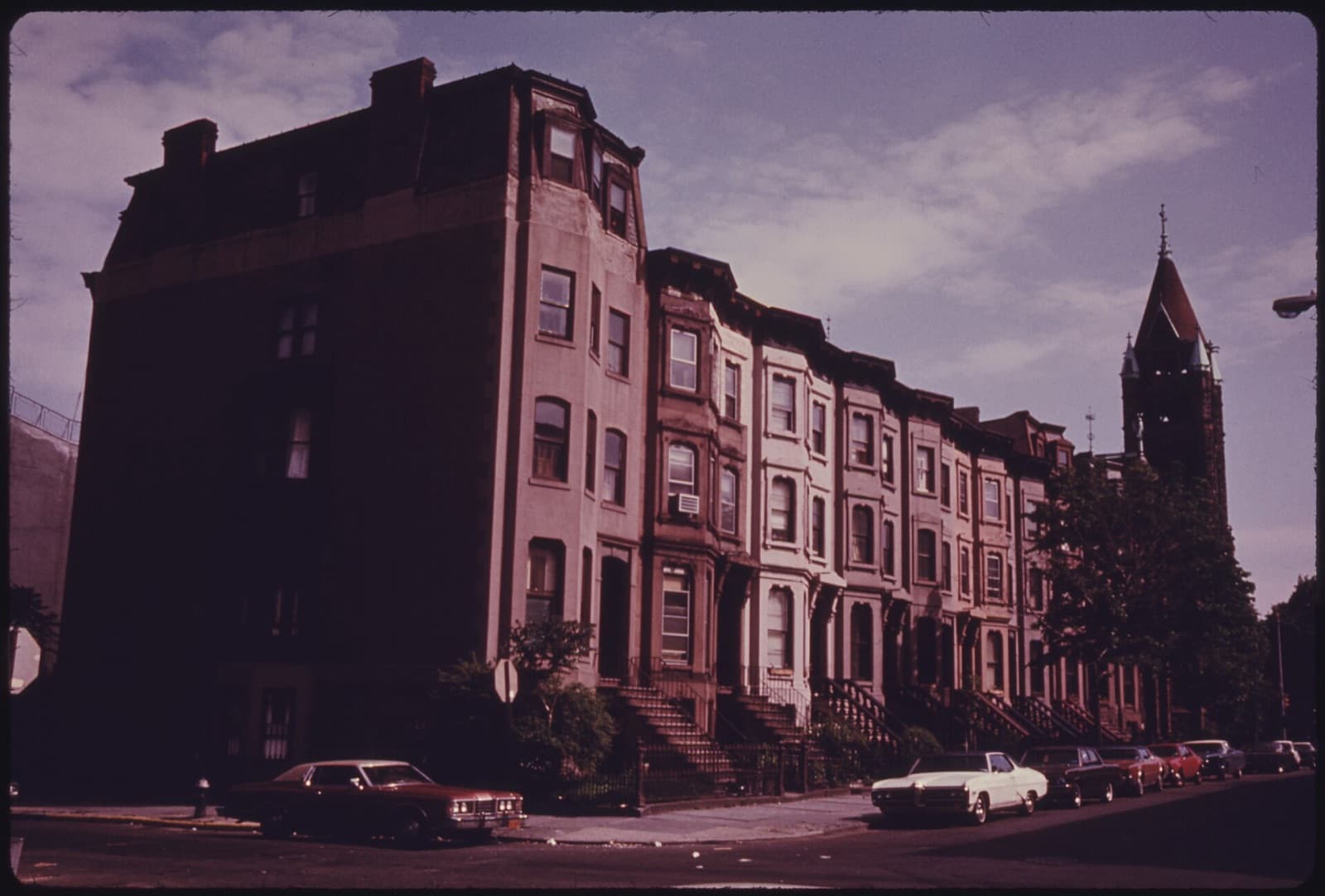
Danny Lyon — Public domain · Wikimedia Commons
Buying your first home in greater New York can feel like being handed a thick instruction manual written in a language you only half-speak. There are pre-approvals and underwriters, escrow and PMI, a rate that moves while you sleep. The good news: the path is more orderly than it looks. Almost every first purchase follows the same seven stations, in roughly the same order. Once you can see the whole map, each step stops feeling like a surprise.
This guide walks that map end to end — what each stage is for, what lenders are actually looking at, and where New York's own programs can lighten the load.
A note on timing: figures below are current as of June 2026. Mortgage rates move weekly and program rules change, so confirm every number with your lender and the official sources listed at the end before you rely on it.
Station 1: Pre-approval (start here, not with listings)
It is tempting to start by scrolling listings. Lenders would tell you to start with a pre-approval. A pre-approval is a lender's written estimate of how much it will lend you, based on a real review of your income, assets, debts, and credit. It is stronger than a "pre-qualification," which is just a back-of-envelope guess.
Why it comes first: in a competitive market, many sellers won't take an offer seriously without one, and the pre-approval tells you your actual budget before you fall for something above it. Expect to share pay stubs, W-2s or tax returns, bank statements, and consent to a credit check. The letter is typically valid for 60 to 90 days.
Station 2: Debt-to-income — the number lenders watch
The single ratio that drives most approvals is debt-to-income, or DTI: your total monthly debt payments (the new mortgage, plus car loans, student loans, credit-card minimums) divided by your gross monthly income.
You may have heard of a "43% rule." That came from the federal Qualified Mortgage framework, but the Consumer Financial Protection Bureau replaced the hard 43% DTI cap years ago with a pricing-based standard. In practice, lenders still scrutinize DTI closely — many comfortable approvals sit somewhere in the 36%–45% range, and some loan types stretch higher with strong compensating factors. The practical takeaway: paying down a credit card or car loan before you apply can do more for your buying power than almost anything else.
Station 3: The down payment (and why 20% is a myth)
The 20%-down assumption keeps many qualified buyers on the sidelines unnecessarily. You generally need less:
| Loan type | Typical minimum down |
|---|---|
| FHA loan (credit score 580+) | 3.5% |
| FHA loan (credit score 500–579) | 10% |
| Conventional loan | Often as low as 3%–5% |
Put down less than 20% on a conventional loan and you'll usually pay private mortgage insurance (PMI), which can be removed later as you build equity. FHA loans carry their own mortgage insurance — both an upfront premium (usually rolled into the loan) and an annual premium paid monthly. Down-payment gift funds from family are generally allowed with proper documentation; ask your lender what's required.
Loan size matters too. For 2026, the baseline conforming loan limit (the line between a conventional and a larger "jumbo" loan) is $832,750, rising to $1,249,125 in high-cost areas — which includes the New York City metro. FHA's 2026 ceiling in high-cost areas is likewise $1,249,125.
Station 4: First-time-buyer programs (FHA and SONYMA)
Two programs do the heaviest lifting for first-time buyers here.
FHA loans, insured by the Federal Housing Administration, exist precisely for buyers with smaller down payments or thinner credit. With a 580 credit score you can put down 3.5%; the trade-off is mortgage insurance that, unlike conventional PMI, often stays for the life of the loan unless you refinance.
SONYMA — the State of New York Mortgage Agency — offers below-market fixed-rate mortgages to first-time buyers, paired with down-payment help. Its Down Payment Assistance Loan (DPAL) is a zero-interest, forgivable second loan with no monthly payments, forgiven after 10 years of ownership. The amount is the greater of $3,000 or 3% of the purchase price, capped at $15,000. Borrowers contribute a minimum of 1% of the property's value in cash (3% for co-ops and 3–4 family homes), and a DPAL typically adds about 0.40% to the mortgage rate. SONYMA loans are for primary residences only, and regional income limits apply and vary by county. A separate, enhanced DPAL Plus program offers larger assistance to lower-income households. Always verify current terms directly with SONYMA.
Station 5: Locking your rate
Once you're under contract, you'll decide when to lock your interest rate. A rate lock freezes your rate (and points) for a set window — commonly 30 to 60 days — protecting you if the market rises before closing. The trade-off: if rates fall, you're generally stuck at the locked rate unless your lock includes a float-down option.
For context, Freddie Mac's weekly survey put the average 30-year fixed rate in the 6.4%–6.5% range through June 2026. That's an average, not a quote — your rate depends on credit, down payment, and loan type. Within three business days of your application, your lender must send a Loan Estimate spelling out the rate, monthly payment, and closing costs. Use it to compare offers from more than one lender; the differences add up over 30 years.
Station 6: Underwriting (the quiet, nerve-wracking middle)
After you apply in earnest, your file goes to an underwriter — the person who verifies everything and decides whether the loan is sound. Expect requests for more documents, a home appraisal (the lender confirming the property is worth the price), a title search, and possibly an explanation for a large or unusual bank deposit.
The cardinal rule of underwriting: don't rock the boat. Don't change jobs, open a new credit card, finance a car, or make a big undocumented deposit between application and closing. Any of these can reopen your file. This stage tests patience more than anything; respond to requests quickly and keep your finances boring.
Station 7: Closing
In the home stretch, federal rules give you a built-in pause. You must receive your Closing Disclosure — which lays out final terms and costs — at least three business days before closing. Compare it line by line against your Loan Estimate; if the rate or fees jumped, ask why before you sign.
At the closing table (in New York, usually with an attorney present), you'll sign the loan documents, pay your down payment and closing costs, and receive the keys. Budget for closing costs beyond the down payment — in New York these commonly run a meaningful percentage of the price and can include attorney fees, title insurance, and taxes.
Where to go from here
The roadmap is linear, but you don't walk it alone — a lender, an attorney, and a knowledgeable agent each cover a different stretch. Whether you're weighing a co-op, a condo, or a house across our neighborhoods, new developments, or gated communities, the financing principles above hold. When you're ready to map your own numbers to real homes, contact our team.
Disclaimer: This article is general educational information only. It is not legal, tax, immigration, or financial advice. Mortgage rules, rates, and program terms change frequently and vary by individual circumstance, lender, and county. Consult a licensed mortgage professional, attorney, or financial advisor, and verify all details with the official sources below before acting. Homix is a licensed New York real estate brokerage, not a lender. Homix supports Equal Housing Opportunity.
Sources
- FHFA — 2026 Conforming Loan Limit Values: https://www.fhfa.gov/news/news-release/fhfa-announces-conforming-loan-limit-values-for-2026
- FHA (fha.com) — Down Payment & Loan Requirements: https://www.fha.com/fha-down-payment
- NYS Homes & Community Renewal — SONYMA: https://hcr.ny.gov/sonyma
- NYS HCR — Down Payment Assistance Loan (DPAL): https://hcr.ny.gov/down-payment-assistant-loan-dpal
- Freddie Mac — Primary Mortgage Market Survey: https://www.freddiemac.com/pmms
- CFPB — Loan Estimate explainer: https://www.consumerfinance.gov/owning-a-home/loan-estimate/
- CFPB — General QM Final Rule (DTI standard): https://www.consumerfinance.gov/rules-policy/final-rules/qualified-mortgage-definition-under-truth-lending-act-regulation-z-general-qm-loan-definition/
Let's talk about your next move.