
Policy & News
Flood Risk and Insurance Before You Buy Waterfront
By Emma (Qian) Niu · May 26, 2026 · 8 min read
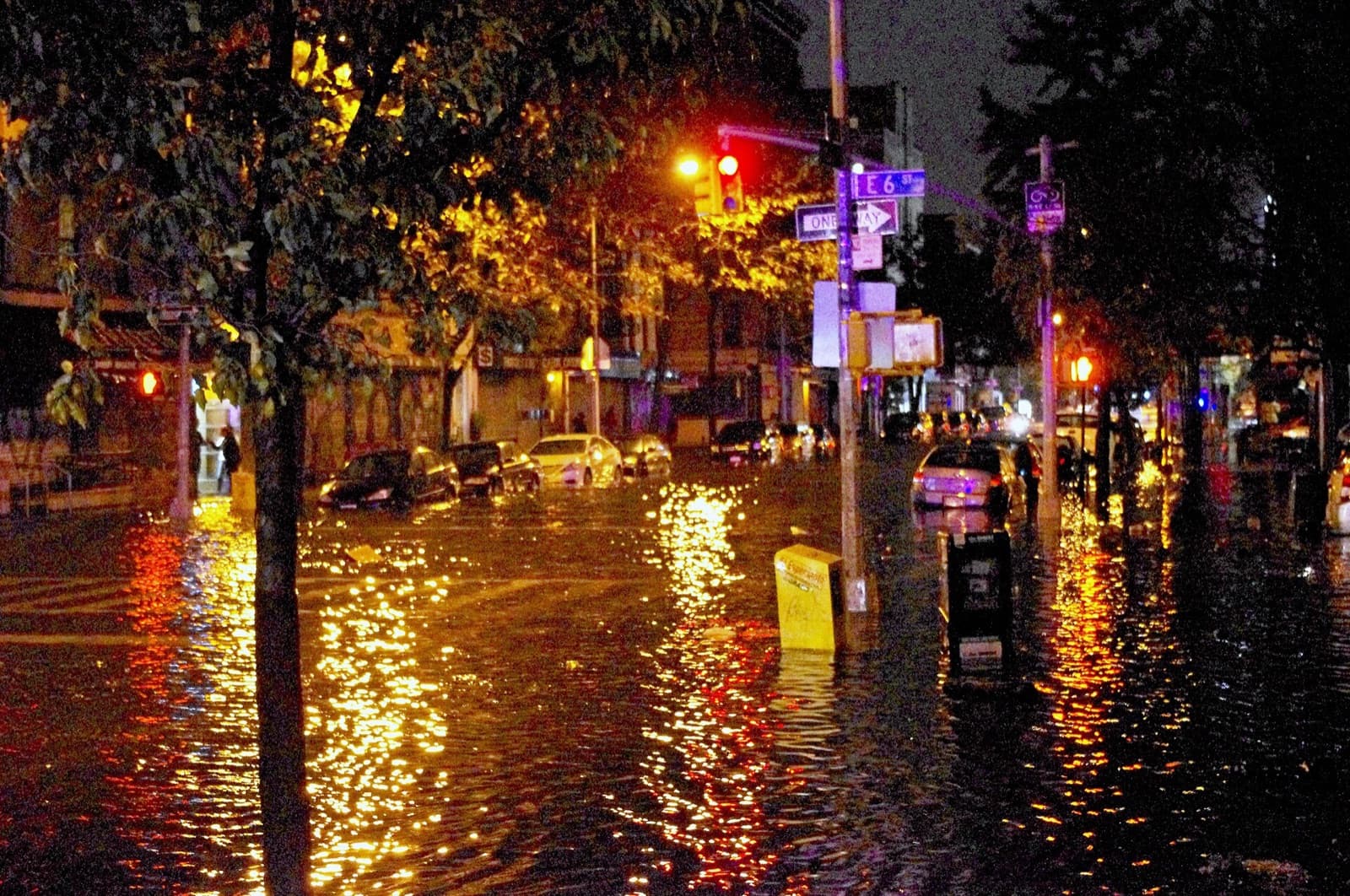
David Shankbone — CC BY 3.0 · Wikimedia Commons
A wide view of the water is one of the most expensive things you can buy in greater New York. Part of that price is the view itself; part of it, often hidden until the closing table, is the cost of insuring a home against the same water that makes it beautiful. Hurricane Sandy reached nearly 88,700 buildings across the five boroughs in 2012, and many of those owners had no flood insurance at all. Nine years later, Hurricane Ida pushed water into basement apartments that had never flooded before. Before you fall for a dock or a bay window, it pays to understand exactly what flood risk you are taking on — and what it costs to carry it.
As of June 2026. Flood maps, insurance rules, and premiums change. Treat the figures below as starting points and verify each one against the official sources listed at the end.
How FEMA flood zones work
The Federal Emergency Management Agency (FEMA) publishes Flood Insurance Rate Maps (FIRMs) that divide the country into flood zones. The key dividing line is the Special Flood Hazard Area (SFHA) — any area with at least a 1% chance of flooding in any given year. That 1%-annual-chance flood is also called the "base flood" or, more familiarly, the 100-year flood. The name is misleading: a property in the SFHA has roughly a one-in-four chance of flooding at some point during a 30-year mortgage.
You will see these zone labels on a map:
| Zone | What it means |
|---|---|
| AE / A | High risk. 1%-annual-chance flood. Zone AE shows a Base Flood Elevation (BFE); Zone A does not. |
| VE / V | High risk, coastal. Same 1% flood plus storm-driven wave action — the most demanding (and expensive) zones. |
| X (shaded) | Moderate risk. Between the 100-year and 500-year (0.2%) flood lines. |
| X (unshaded) | Minimal risk, outside the SFHA. |
The Base Flood Elevation (BFE) is the height floodwater is expected to reach in a base flood. The relationship between your lowest floor and the BFE is one of the single biggest factors in both your risk and your premium.
How to check any property's flood map
You do not need to wait for a seller's disclosure. Go to FEMA's Flood Map Service Center at msc.fema.gov, enter the exact address, and view the official map. You can download a "FIRMette" — a printable excerpt of the rate map — to keep with your file. This is the authoritative public source.
Two cautions. First, maps are updated over time, and a home built decades ago may sit in a zone that has since changed. Second — and this is the lesson of both Sandy and Ida — more than half of the buildings flooded by Sandy were outside FEMA's 100-year floodplain. A "minimal risk" label is not a guarantee. For low-lying or coastal listings on our listings page, or any new developments near the water, check the map yourself before you write an offer.
When flood insurance is required — and when it's just smart
If you finance a home in a high-risk zone (an SFHA) with a federally backed or federally regulated mortgage — which covers most loans — federal law requires you to carry flood insurance for the life of the loan. This is the mandatory purchase requirement. Outside the SFHA, it is optional, but given how much Sandy- and Ida-era flooding fell outside the mapped high-risk areas, "optional" and "unnecessary" are not the same thing.
One critical timing rule: a new NFIP policy generally takes effect only after a 30-day waiting period. The major exception is a policy bought in connection with a mortgage — that coverage is generally effective at closing, as long as you apply and pay at or before closing. Plan for this so you are not caught uninsured on day one.
NFIP versus private flood insurance
There are two markets. The National Flood Insurance Program (NFIP), run by FEMA, is the traditional source. Its coverage is standardized but capped: residential building coverage maxes out at $250,000, and personal property (contents) at $100,000. For many waterfront homes in our market, that building cap is well below replacement cost.
The private flood insurance market has grown to fill the gap. Private policies can offer higher limits, extra coverages (such as additional living expenses), and sometimes lower prices. Since a 2019 federal rule, a qualifying private policy that is "at least as broad as" NFIP coverage satisfies the mandatory purchase requirement — a lender is not supposed to reject all private policies out of hand. The trade-off: private carriers can be more selective and may re-rate or non-renew based on their own risk models. Many owners of higher-value homes pair an NFIP base policy with private excess coverage above the $250,000 cap.
What drives the premium
Since FEMA fully implemented its current pricing methodology, Risk Rating 2.0, in 2023, NFIP premiums reflect the specific features of each individual property rather than a broad zone-wide rate. The factors include:
- Distance from water and the type of flooding (coastal surge vs. river vs. rainfall).
- Flood frequency for that location.
- Elevation of the lowest floor relative to the BFE — height is protection.
- Foundation type (a slab, a crawlspace, and a basement carry very different risk).
- Replacement cost of the structure and prior claims history.
Nationally, FEMA reports the average NFIP premium is roughly $900–$950 a year, but that average hides enormous spread. Typical new policies have run from a few hundred dollars to around $1,500, while high-risk coastal properties — exactly the kind of waterfront home this article is about — can exceed $2,800 and, in VE zones, go much higher. An Elevation Certificate prepared by a surveyor can sometimes lower a premium materially if your lowest floor sits above the BFE.
Lessons from Sandy and Ida — and the climate horizon
The two storms taught different lessons. Sandy (2012) was a coastal-surge event; its damage clustered along the shoreline and in low-lying zones, and the painful surprise was how many flooded homes carried no insurance — after a contested claims review, FEMA ultimately paid out roughly $258 million in additional Sandy claims. Ida (2021) was a rainfall event: water fell faster than storm drains could carry it, flooding inland and basement spaces that no coastal map had flagged.
Together they point to one conclusion for a buyer today: flood risk is not static, and it is not confined to the blue lines on an old map. As you weigh a waterfront condo, a bayfront house, or a home in one of the region's gated communities or coastal neighborhoods, price the insurance as a permanent line item — not a one-time hurdle — and ask how the figure has moved over the past few years.
A practical checklist before you offer
- Pull the address on msc.fema.gov and save the FIRMette.
- Ask the seller for any past flood claims, an Elevation Certificate, and prior premium bills.
- Get both an NFIP quote and at least one private quote before you commit.
- Confirm the 30-day waiting period won't leave a gap at closing.
- Factor the annual premium — and its likely trajectory — into your real monthly cost.
Want help reading a specific property's flood map or lining up quotes? Contact our team and we will walk through it with you.
Disclaimer. This article is general educational information, not legal, tax, financial, or insurance advice. Flood maps, program rules, coverage limits, and premiums change, and every property is different. Consult a licensed insurance agent, your lender, and official FEMA resources for guidance on your specific situation, and verify all figures against the official sources below before acting.
Sources
- FEMA — Flood Insurance & Risk Rating 2.0: https://www.fema.gov/flood-insurance/risk-rating
- FEMA — Cost of Flood Insurance for Single-Family Homes: https://www.fema.gov/flood-insurance/work-with-nfip/risk-rating/single-family-home
- FEMA — Flood Map Service Center: https://msc.fema.gov/portal/search
- FEMA — Flood Zones glossary: https://www.fema.gov/about/glossary/flood-zones
- FEMA — Flood Insurance overview: https://www.fema.gov/flood-insurance
- Congressional Research Service — Introduction to the NFIP: https://www.congress.gov/crs-product/R44593
- RAND — Flood Insurance in New York City Following Hurricane Sandy: https://www.rand.org/pubs/research_reports/RR328.html
- NYC Environment & Health Data Portal — Flooding and Health (Ida & Sandy): https://a816-dohbesp.nyc.gov/IndicatorPublic/data-stories/flooding-and-health/
Let's talk about your next move.