Market Data
The New Jersey "Gold Coast" in 2026: Jersey City, Hoboken & Edgewater
By Queenie Zhuang · May 23, 2026 · 8 min read
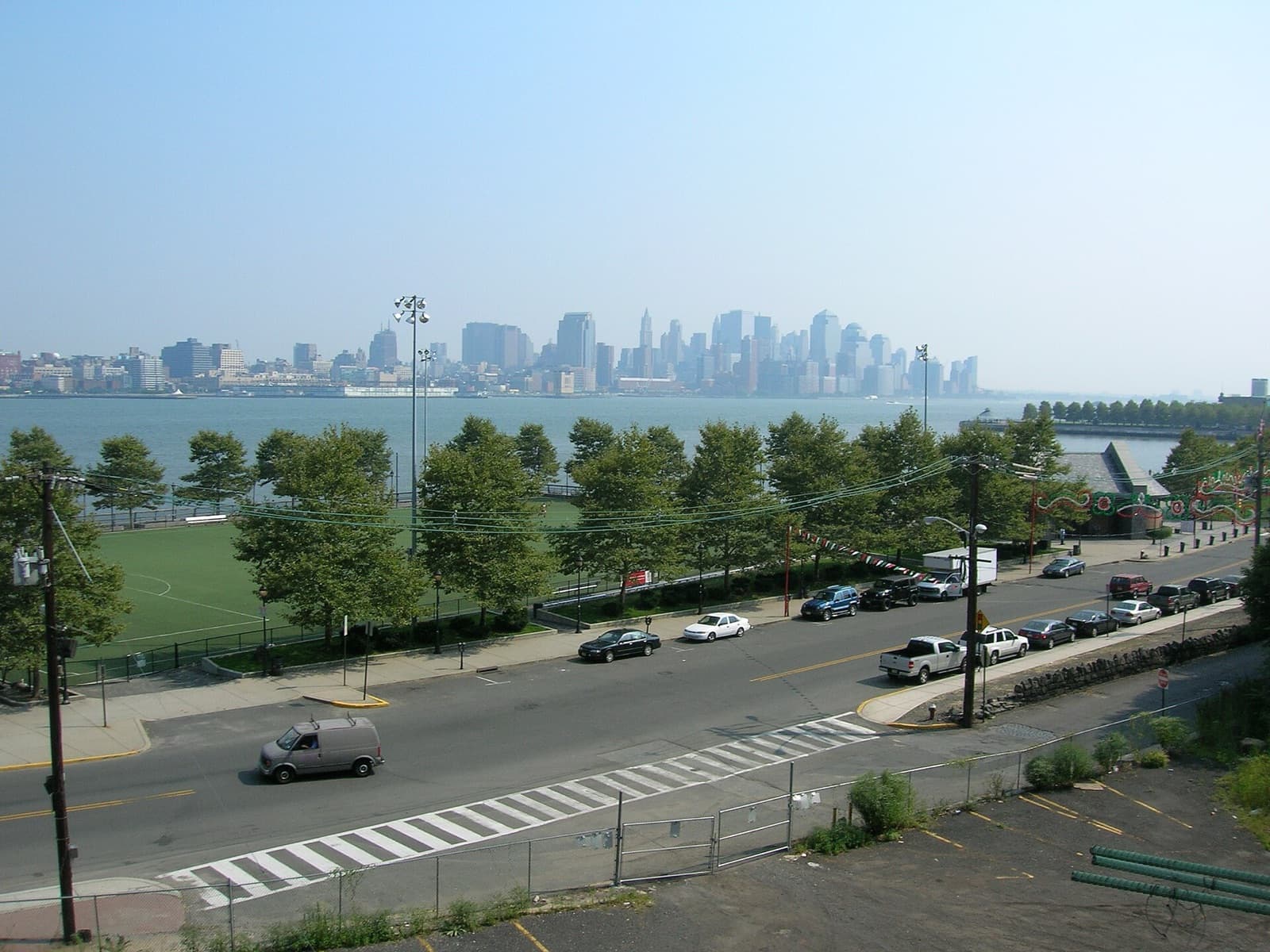
Sharkface217 — Public domain · Wikimedia Commons
Stand on the Hoboken or Edgewater waterfront at dusk and the pitch makes itself: the same Midtown skyline that costs a fortune to live inside is right there across the water — close enough to read the lights, far enough to cost meaningfully less. For a decade, New York buyers priced out of Manhattan and brownstone Brooklyn have crossed the Hudson to the strip of towns realtors call the "Gold Coast": Jersey City, Hoboken, and Edgewater. In 2026 the math that drives that move is still intact, but the details have shifted. Here is a grounded read.
A note on timing: all figures below are as of June 2026 and move constantly. Treat them as a snapshot, not a quote.
Why buyers cross the river
The first reason is almost always price. In Q1 2026 the Manhattan median sale price for condos and co-ops combined was about $1,225,000, up roughly 5% year over year, per the Douglas Elliman / Miller Samuel report. Across the river, recent Redfin data put Jersey City's median sale price near $720,000 and Hoboken's near $975,000 for the three months ending in spring 2026. The same dollar that buys a one-bedroom in Manhattan often buys a two-bedroom with a parking spot on the Jersey side — a difference that compounds when you factor in space per dollar rather than headline price.
The second reason is the commute, which is the whole reason the price gap can be as small as it is. The PATH train connects Hoboken, Newport, Grove Street, Exchange Place, and Journal Square to Lower Manhattan (World Trade Center) and Midtown (33rd Street) at a flat fare — $3.00 per ride as of the May 2026 fare adjustment. NY Waterway ferries run from Hoboken, Edgewater, and Weehawken directly to Midtown and Wall Street; fares rose in May 2026, so confirm the current price for your specific landing before you bank on it. For an Edgewater buyer with no PATH stop nearby, the ferry — or a bus up the Palisades — is the practical link to the city.
The third reason is lifestyle trade-off rather than pure economics: more square footage, in-building parking, newer construction along the waterfront, and a shorter door-to-desk time than many outer-borough options. None of that is unique to any one buyer profile — it is simply the logistics that make the move pencil out.
A current market read, town by town
| Town | Approx. median sale price (spring 2026) | Primary transit to NYC |
|---|---|---|
| Jersey City | ~$720,000 | PATH (multiple stops), ferry, light rail |
| Hoboken | ~$975,000 | PATH, NY Waterway ferry, NJ Transit |
| Edgewater | Varies widely by building | NY Waterway ferry, bus |
Jersey City is the largest and most varied of the three. Downtown and the waterfront (Newport, Exchange Place, Paulus Hook) carry the highest prices and the most new high-rise inventory; neighborhoods farther from the PATH typically trade lower. Redfin data showed Jersey City's median roughly flat to slightly down year over year in spring 2026, which — after years of steep gains — points to a more balanced market where buyers have a little more room to negotiate.
Hoboken is smaller, denser, and almost entirely walkable, with the PATH and ferry at its edge. Its median sits well above Jersey City's, and the mix skews toward condos and brownstone-style multifamily; true single-family homes are rare and priced accordingly. Reported year-over-year movement has been choppy, which is normal in a small market where a handful of high-end closings can swing the median.
Edgewater is the outlier: a narrow ribbon between the Palisades cliffs and the river, with no PATH and a heavy reliance on the ferry and bus. Inventory is dominated by waterfront condo complexes, so "median price" is less meaningful than the price of the specific building and unit you are looking at.
The financing backdrop
Whatever you pay, the rate matters. Through June 2026 the Freddie Mac 30-year fixed mortgage averaged in a narrow band of roughly 6.47%–6.52% — stable, but well above the sub-4% rates many remember from 2021. If you are comparing a New York purchase to a New Jersey one, run both at today's rate, not a remembered one, and stress-test the monthly payment against property taxes and HOA dues, which differ sharply by state and building. For help modeling a specific scenario, contact our team.
Taxes: the part that surprises New Yorkers
New Jersey's property taxes are, on average, among the highest in the nation, and that is the line item that most often surprises buyers coming from a New York co-op. Effective rates vary widely by municipality — the New Jersey Division of Taxation publishes the official tables — so the rate in one waterfront town can differ materially from the next. The practical takeaway: never compare two homes on price alone. A lower sticker price with a higher annual tax bill can land at the same monthly cost as a pricier home next door. Ask for the actual current tax bill on any specific property.
Two more items to plan for:
- The "mansion tax" / realty transfer fees. New Jersey overhauled its supplemental transfer fees in 2025. For deeds on or after July 10, 2025, the seller is responsible for the supplemental fee on residential sales over $1 million, and the fee is now tiered: 1% from $1M–$2M, rising in steps to a maximum of 3.5% above $3.5M (per the signed amendments to A5804). At the Gold Coast's higher price points this is a real number — build it into any negotiation.
- State income tax and SALT. New Jersey and New York both levy state income tax, and the federal deduction for state and local taxes (SALT) is a moving target in Washington. This interacts with high property-tax bills in ways that are specific to your income and filing situation, so model it with a professional rather than assuming a rule of thumb.
Flood risk and insurance — do not skip this
The Hudson waterfront is, by definition, waterfront. Large stretches of Hoboken and the Edgewater and Jersey City shoreline sit in FEMA-mapped flood zones (commonly Zone AE, the 1%-annual-chance "100-year" floodplain), and lenders generally require flood insurance for a federally backed mortgage on a property in a high-risk zone. Before you fall for a view, look up the address on the FEMA Flood Map Service Center and get a written flood-insurance quote; premiums and elevation requirements vary building by building. FloodSmart.gov explains how the National Flood Insurance Program works. A ground-floor unit and a tenth-floor unit in the same tower can carry very different risk and cost profiles.
So, is the Gold Coast worth it in 2026?
For many New York buyers, the core trade still holds: more space and a lower (or comparable) all-in monthly cost, traded against a state line, a different tax regime, and a transit link that depends on the PATH or a ferry running on time. The price gap to Manhattan is real, the commute is genuinely workable, and 2026's flatter, more balanced market gives buyers more leverage than the frenzied years did. The caveats — property taxes, the 2025 transfer-fee changes, and flood exposure — are exactly the things a sticker price hides, which is why they belong at the front of your diligence, not the end. Browse current listings and waterfront new developments, and bring questions specific to the building and the address.
This article is general educational information, not legal, tax, immigration, or financial advice. Real estate rules, tax laws, fees, mortgage rates, and flood maps change frequently and vary by property and by individual situation. Verify everything against official sources and consult a licensed attorney, tax professional, mortgage lender, or insurance agent before making any decision. Homix is a licensed New York real estate brokerage and does not provide legal or tax advice.
Sources
- Redfin — Jersey City and Hoboken housing markets
- Corcoran — Manhattan 1Q 2026 market report and Miller Samuel / Douglas Elliman
- Freddie Mac Primary Mortgage Market Survey (PMMS)
- PATH (Port Authority of NY & NJ) and NY Waterway fares & schedules
- NJ Division of Taxation — Hudson County 2025 abstract of ratables
- Saul Ewing — 2025 NJ "mansion tax" / realty transfer fee amendments (A5804)
- FEMA Flood Map Service Center and FloodSmart.gov (NFIP)
Let's talk about your next move.